ABOUT THE ARTIST
Biography
Lauren Boilini was born and raised in Bloomington, Indiana. She received her BFA in Painting and Art History at the Kansas City Art Institute and her MFA at the Maryland Institute College of Art. As a painter she also works in installation and public art, completing exhibitions and projects up and down both coasts. Traveling to and participating in artist residencies has been an important part of her practice. She has served as an artist-in-residence at Can Serrat in Spain, Jentel Arts in Wyoming, Soaring Gardens in Pennsylvania, the Studios of Key West, the Creative Alliance and School 33 Art Center in Baltimore, and as a Consortium Resident at the Studio Art Centers International (SACI) in Florence, Italy. She was invited as an artist-in-residence to the Burren College of Art in Ireland and received a full fellowship to the Vermont Studio Center in 2012. She has completed public art projects for the Maryland Department of Public Health and the Greenville-Spartanburg Airport. In 2016 she was awarded a GAP grant to publish a book of drawings and spent the summer of 2019 as an artist-in-residence at MASS MoCA working on the sequel, which she completed for a solo exhibition at Furman University in South Carolina in 2020. In the winter of 2022 she opened a solo exhibition at Pacific Lutheran University in Tacoma and began work on the third in a trilogy of artist books while artist-in-residence at Amazon’s headquarters in spring 2023. The following fall she worked with the Open AIR program in Montana as the first artist-in-residence at the Missoula Butterfly Museum and a fellowship from the McMillen Foundation helped to fund a residency on Vashon Island this past summer.
In addition, she currently teaches studio art and art history at The Evergreen State College. Collaborations with a number of different artists in her close-knit community have been vital to the development of her work and she looks forward to future opportunities to expand that practice. Lauren is also a marathon open water swimmer and with her immediate family close by, she loves to call Seattle home.
STATEMENT
In my current body of work I look at the idea of excess, when images of excess become meaningless and fall into the realm of pattern. This idea of gluttony is reflected in our current culture. We are a hedonistic society, always looking for more until the more we are looking for loses its meaning.
My studio practice has consistently been painting, often extending into the realm of installation. Research, reading and exploration are vital to my process, consistently driving my work forward. I continuously seek and study epic narratives, creating my own for each work. I am fascinated with crowds of beings converging in one space at one time. This includes religious practices, festivals, political gatherings, orgies, feeding frenzies, stampedes, riots, migrations, etc. The pattern and beauty that emerges from these chaotic scenes pulls me into the studio to recreate that same energy.
Recently I have been drawn to images of battles and duels; I am interested in what drives us to violence and destruction of life. My dismay paired with the attraction I feel for the conflict that I see around me leads me towards research into how violence in the animal kingdom mirrors our own, and particularly where it overlaps with human behavior. Violence is most often a problem of gender and I work to understand why. This drives me to look at what is nature and what is nurture, always searching for answers, and puzzling through the beauty I find at that intersection
SPOTLIGHT ON THE ARTIST
-
Some of these paintings are inspired by time I spent living with a partner on the Kitsap Peninsula, specifically through the height of the pandemic. He had a large group of peafowl, also known as a muster, an ostentation or a pride, living on his property. What had started as a peacock and peahen pair who had wandered from their original home on Bainbridge Island and found their way to Kingston, expanded into a family of ten or so who had set up shop on his 2.5 acres. They are particularly territorial birds, very noisy and aggressive, with a disturbingly human screech and they drove us mildly crazy during lockdown. I would wake every morning to a peacock at each of the glass doors, standing on the deck and porches, glaring indignantly at their own reflections, opening their massive plumage and shaking their feathers. These daily rituals and their loud calls became the soundtrack for our time together in the pandemic. Literature and music also provide enormous influence on me while I am painting, so at that time I also read Flannery O’Connor’s essay Living with a Peacock written in 1961. This insight into her life and personal passion for peacocks provided a thoughtful contrast to my surreal experience. That initial inspiration led me to find all kinds of creatures who mimic or are named after peacocks: peacock moths, peacock butterflies, peacock pheasants, etc. I am fascinated by the ways that animals deter predators through disguise, sometimes with large designs that imitate eyes.
-
Titles are absolutely critical to me. They open up possibilities for the viewer and help guide conversations about the work. Also, I spend so much time alone in the studio that I have to find ways to amuse myself, so titles are often very personal, inside jokes. One in particular is Nocturnal Emissions. As a Midwesterner living in Seattle, I am most nostalgic for fireflies. Due to light pollution and climate change, firefly population has dropped drastically, so I am also documenting a phenomenon that I may outlive. I love the way that their butts make little gestural paintings in the air. As I begin a painting, I often write about specific painters who inspire what I am working on, studying their compositions and colors, sometimes reading their writing. Some notes from my sketchbook include 2 quotes:
“The only obligation of a painting is to be a feast for the eyes.” - Eugène Delacroix
“The only obligation of a painting is to be a Swiss Army knife.” - Cecily Brown
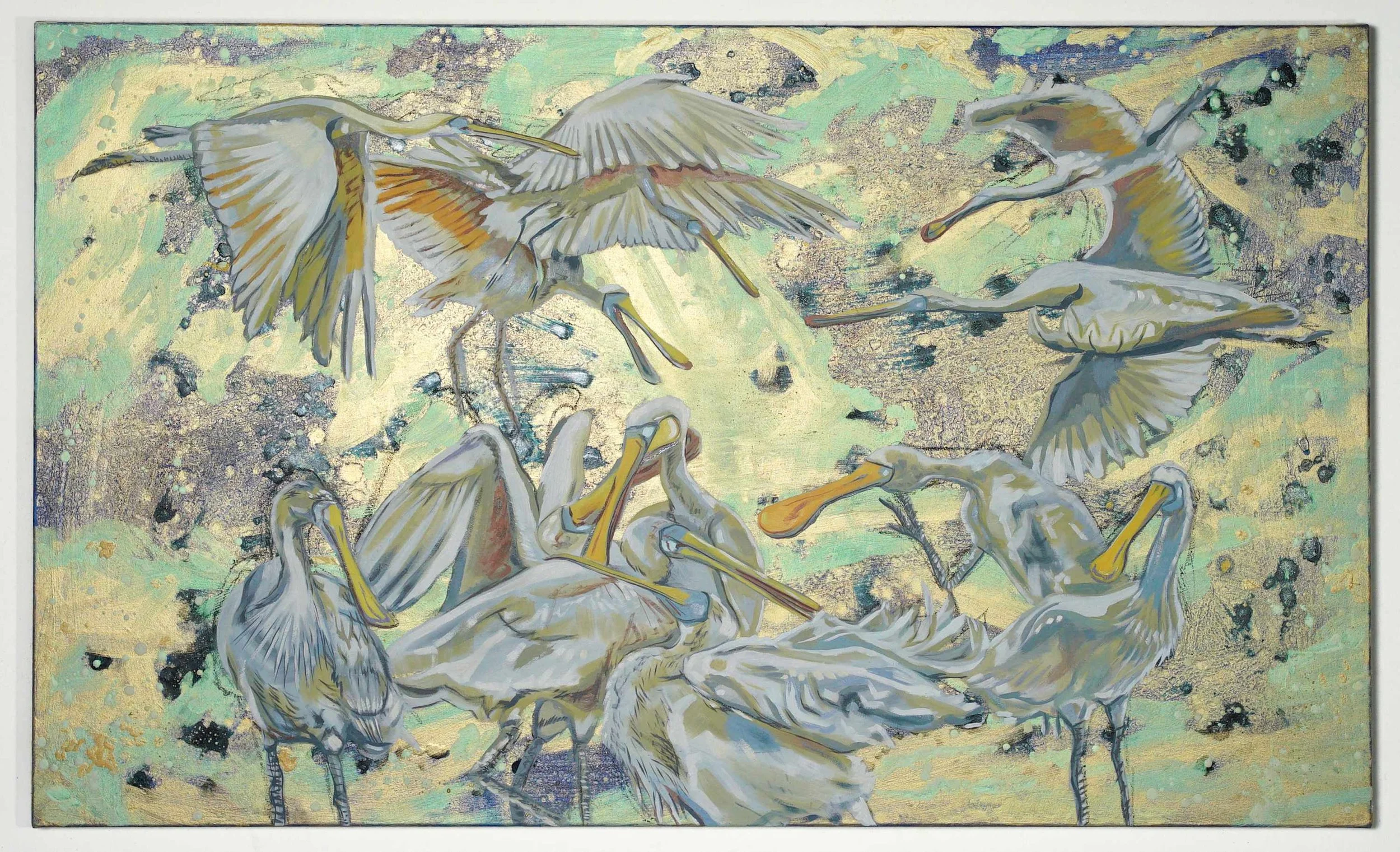
These two quotes help me as I begin planning a composition, along with something Degas is credited as saying, that “paintings are not states of mind, but state of eye”. To me, paint is a metaphor for physical pleasure: very bodily, very squishy - the oiliness feels like something internal, expressed externally. As I mix colors, I often think of chromophobia - that the Western world fears color because it might mean we are out of control. I knew that the contrast and saturation of these particular birds would be a platform to push those concepts, that it would be combative - passion vs reason, chaos vs control. I want the degree of chromatic intensity of the paint itself to be an imitation of the absurd saturation of nature, recognizing how life imitates art, and that art can imitate art, all the while art imitates life.
-
I have developed a love for buying art myself, so I highly recommend people take the leap and just do it! There is no downside. It's immensely rewarding and empowering, both for you as the collector and the artist. I'm working on building a practice of purchasing a piece from an artist each time I, myself, make a sale.
-
For the artwork in the “Patterns” show specifically: I have a fear of negative space and corners and I believe painting is a marriage of brain and body. This work came from a short story by Melissa Faliveno about surviving loneliness through an infestation of moths, an homage to Virginia Woolf’s essay “Death of a Moth” about how the struggles and life cycle of a moth parallel our own as humans.
-
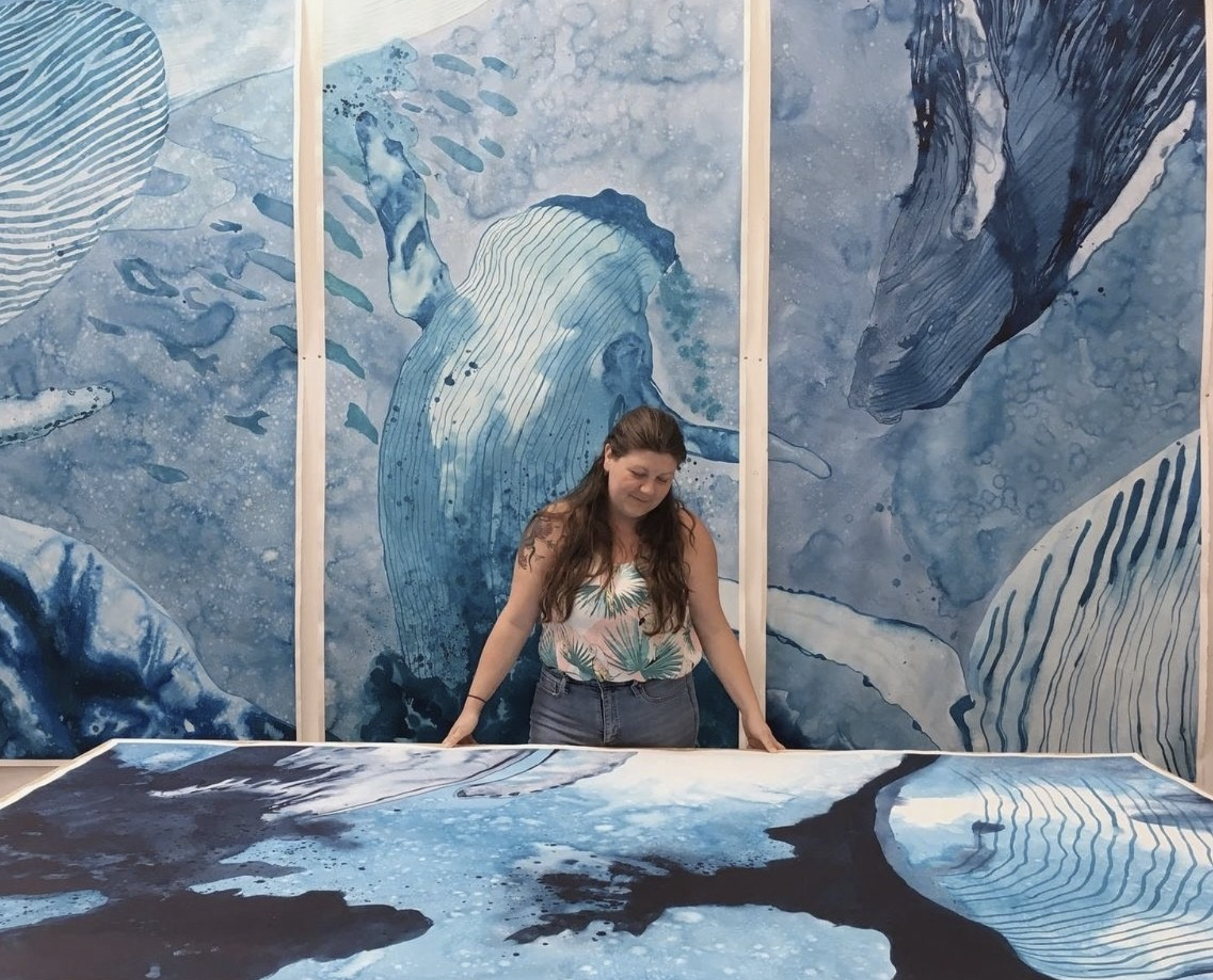
In early 2020, directly before the pandemic hit, my studio neighbor and frequent collaborator, Henry Cowdery and I insta led a site-specific project at Oxbow in Seattle, WA. Henry and I met in 2016 working for the same large-scale sculptor, John Grade, fabricating a number of public art pieces together. We applied for a residency at Oxbow about nine months before our installation date, using the time leading up to it for fabrication. The residency itself was five weeks in length, and we spent almost every waking minute in the space. After working together for four years, day in and day out, problem solving the ever evolving challenges of large-scale sculpture, it was immensely rewarding to execute our own vision. The installation itself was a reimagining of a whale fall. When a whale dies it falls to the floor of the ocean and decomposes, becoming food for countless organisms, similar to the nurse logs we see here in the Pacific Northwest. We wanted this immersive installation to be something our viewers could enter into and experience as if they were walking onto the sea floor, surrounded by death providing new life. We called the show "Underbelly". As a designer and sculptor, Henry drew models of new species of fish, crab and isopods, printing them on his 3D printer, casting the positives with silicone, and then filling the negatives with a mixture of recycled paper pulp (blow-in insulation) and wax. We spent months casting these creatures, dying them different colors, creating a menagerie of decaying sea life. Once we entered the space at Oxbow, I built a false floor, painting it and the walls to create an elaborate underwater atmosphere. We suspended the hundreds of fish from wire grids on the ceiling and began fabricating a paper-maché whale directly in the space, and enlisted a couple of friends to assist. Throughout the residency period we had open studio hours, where anyone from the community could enter and watch us work. After five weeks, the piece was complete. We had a closing reception and removed the entire installation the next day. This turned out to be one of the last things we would do as a community since the pandemic hit not long after and we all needed to remain isolated. At the end of that challenging year, Henry and I were reunited with our whale, which we brought to the beach during the Winter solstice, lit it on fire and watched it burn down to ash on the sand. I learned a tremendous amount from this collaborative project and I enjoyed every minute of it. Henry and I still see each other every day and are currently developing a large project for SeaTac Airport’s South Concourse, slated for 2034!